讲座信息
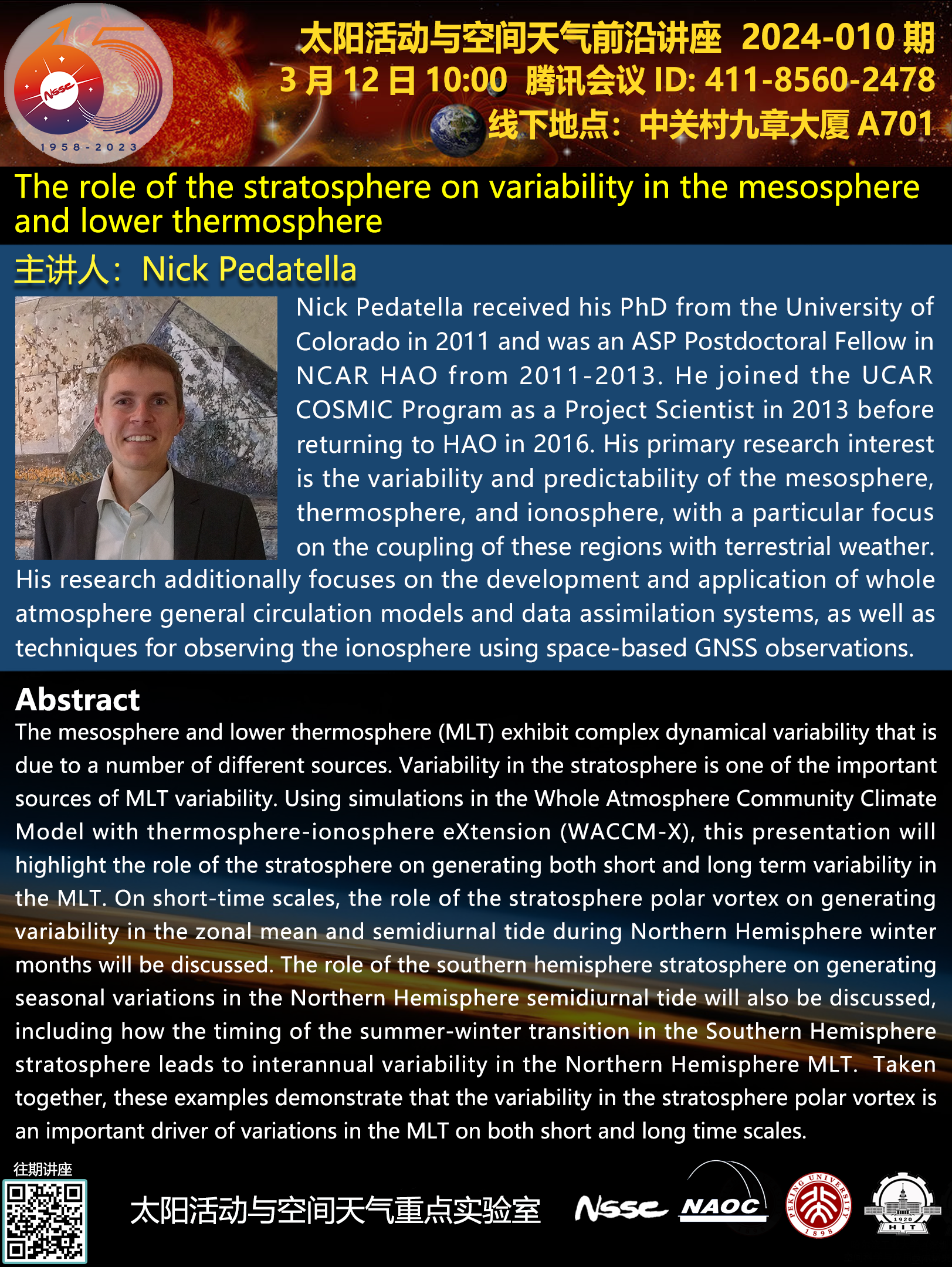
讲座题目:The role of the stratosphere on variability in the mesosphere and lower thermosphere
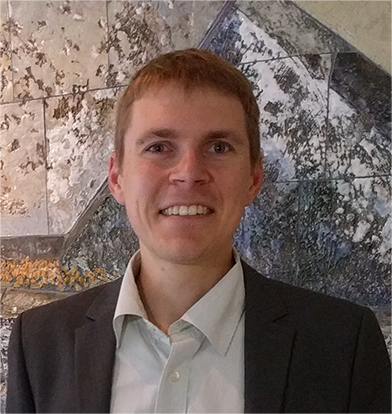
讲座嘉宾:Nick Pedatella(HAO高山天文台)
讲座主持人:何茂盛(中国科学院国家空间科学中心)
时间:3月12日10点
地点:线上 腾讯会议 411-8560-2478 (点此入会)
线下 中关村九章大厦A701
讲座摘要
The mesosphere and lower thermosphere (MLT) exhibit complex dynamical variability that is due to a number of different sources. Variability in the stratosphere is one of the important sources of MLT variability. Using simulations in the Whole Atmosphere Community Climate Model with thermosphere-ionosphere eXtension (WACCM-X), this presentation will highlight the role of the stratosphere on generating both short and long term variability in the MLT. On short-time scales, the role of the stratosphere polar vortex on generating variability in the zonal mean and semidiurnal tide during Northern Hemisphere winter months will be discussed. The role of the southern hemisphere stratosphere on generating seasonal variations in the Northern Hemisphere semidiurnal tide will also be discussed, including how the timing of the summer-winter transition in the Southern Hemisphere stratosphere leads to interannual variability in the Northern Hemisphere MLT. Taken together, these examples demonstrate that the variability in the stratosphere polar vortex is an important driver of variations in the MLT on both short and long time scales.
嘉宾介绍
| Nick Pedatella received his PhD from the University of Colorado in 2011 and was an ASP Postdoctoral Fellow in NCAR HAO from 2011-2013. He joined the UCAR COSMIC Program as a Project Scientist in 2013 before returning to HAO in 2016. His primary research interest is the variability and predictability of the mesosphere, thermosphere, and ionosphere, with a particular focus on the coupling of these regions with terrestrial weather. His research additionally focuses on the development and application of whole atmosphere general circulation models and data assimilation systems, as well as techniques for observing the ionosphere using space-based GNSS observations. |